
Georgia Learner’s Permit Practice Test 2026 [500+ Questions]. Thinking about getting your learner’s permit in Georgia? Before you can hit the road, you’ll need to pass the knowledge test at the DDS (Department of Driver Services).
Don’t worry if you prepare the right way, it’s not as scary as it sounds. One of the best tools to help you get ready is a Georgia learner’s permit practice test. A lot of new drivers think, “I’ll just read the manual once and I’ll be fine.” But when you sit down in front of that computer at the DDS, the questions can feel tricky.
Georgia Learner’s Permit Practice Test 2026
Try our free Practice tests and see what the authentic question style looks and feels like. The Georgia learner’s permit test has two main sections: Road Rules and Road Signs. In the actual test, you’ll answer 40 multiple-choice questions, and you need to get 30 right to pass. That means 15 correct on each section.
| Easy | Medium | Hard | Road Sign Tests |
| GA DMV Test 1 | GA DMV Test 1 | GA DMV Test 1 | Shape and Color |
| GA DMV Test 2 | GA DMV Test 2 | GA DMV Test 2 | Regulatory Signs |
| GA DMV Test 3 | GA DMV Test 3 | GA DMV Test 3 | Warning Signs |
| GA DMV Test 4 | GA DMV Test 4 | GA DMV Test 4 | Other Road Signs |
Written test structure
In Georgia, if you’re at least 15 years old, you can go for your learner’s permit, officially called the Instructional Permit (Class CP). This permit allows you to drive with a licensed adult who’s at least 21 years old sitting next to you. The test itself checks if you know the basics: road signs, traffic rules, and safe driving habits.
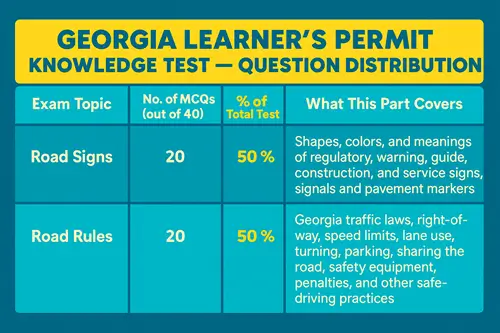
Based on the Georgia Driver’s Manual (2026) and the written test structure, here’s a simple and straightforward table showing the exam content topics and the percentage of multiple-choice questions (MCQs) for each section on the Georgia Learner’s Permit Knowledge Test:
| Exam Topic | No. of MCQs (out of 40) | % of Total Test | What This Part Covers |
|---|---|---|---|
| Road Signs | 20 | 50 % | Shapes, colors, and meanings of regulatory, warning, guide, construction, and service signs; signals and pavement markers |
| Road Rules | 20 | 50 % | Georgia traffic laws, right-of-way, speed limits, lane use, turning, parking, sharing the road, safety equipment, penalties, and other safe-driving practices |
1. What is the Georgia knowledge test for a learner’s permit?
- It’s a written test that checks your understanding of road signs and road rules. You need to pass this test to get your Class C Instructional Permit (CP).
2. How many questions are on the written test?
- There are 40 multiple-choice questions in total—20 on road signs and 20 on road rules. You must get at least 15 correct in each section to pass.
3. How much does it cost to take the written test?
- The fee is $10, and it must be paid before testing. If you fail, the fee is not refunded—you’ll need to pay again to retake it.
4. Can I use my phone, notes, or talk during the test?
- No. Phones, notes, and talking are strictly prohibited. Misconduct will count as a test failure, and you’ll have to come back another day.
5. Is the written test available in other languages?
- Yes, the road rules test is available in some non-English languages, but the road signs test is only in English. You must also demonstrate your ability to read basic English road signs.
6. What happens if I fail the written test?
- 1st failure: You must wait until the next day to try again.
- 2nd or more failures: You must wait 7 days before retesting.
7. What do I need to bring to take the written test?
You’ll need:
- Proof of identity and Georgia residency
- Social Security Number (or proof of ineligibility)
- If under 18: school enrollment proof and a signed consent form from a parent or guardian
8. Can I take a practice test online?
- Yes. You can take a free practice test on the official DDS website: dds.georgia.gov. This helps you get familiar with the format and topics.
9. What topics are covered in the test?
- Road Rules: Speed limits, right-of-way, signs, signals, penalties, safe driving
- Road Signs: Warning signs, stop/yield signs, regulatory signs, lane use, construction signs
10. Where do I take the test and when should I go?
- You can take the written test at any DDS Customer Service Center, but you must start at least 30 minutes before closing. Check the location and hours at dds.georgia.gov.;
Study Guide
The Georgia Driver’s Manual is your best friend. It’s got everything you need to know for the test—road signs, rules, all of it. You can download it from the DDS website or pick up a copy at a DDS office. Read it, highlight key points, and make notes. It’s not the most exciting book, but it’s gold.